
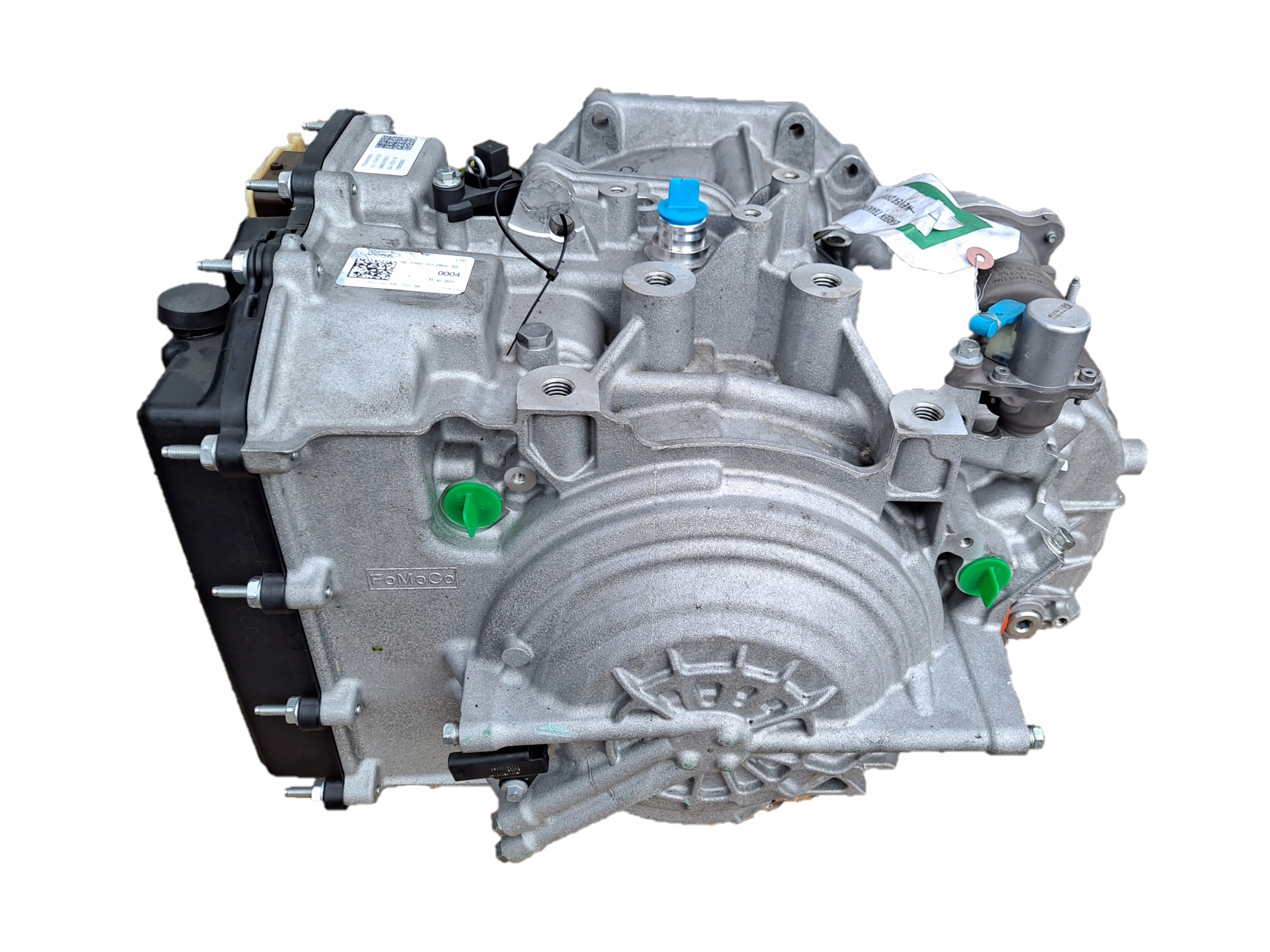
Ford 8F35 8-Speed Automatic Transmission: Reliability and Failure Analysis
Forget what the brochure says. The Ford 8F35 isn’t just a “better” 6F35 with two more gears. It’s a different transmission architecture, developed alongside GM’s 9T family, but Ford uses its own eight-speed gear arrangement, controls, calibrations, and application-specific hardware.
Here’s the rub for us technicians and the owners footing the bill: this unit operates with tight hydraulic and electronic control. It uses Ultra-Low Viscosity (ULV) fluid—basically red water—and a precise solenoid strategy where contamination, incorrect fluid level, or the wrong calibration can quickly affect shift quality. Old hydraulic units? You could sometimes run them on tired fluid and hope. The 8F35 relies on skip-shift logic, adaptive clutch control, and a Selectable One-Way Clutch (SOWC). Neglect the fluid or ignore developing symptoms, and you may end up dealing with more than a rough shift.
This isn’t a polished review. This is a look from the lift. I’m going to walk you through what actually breaks, why the 150,000-mile normal-service interval deserves context, and how to maintain the transmission without confusing sensible prevention with internet mythology.
Important: This article applies to the conventional 8F35 eight-speed automatic used with engines such as the 2.0L EcoBoost. It does not apply to the Ford Maverick Hybrid eCVT, which is a completely different transmission design.
Specs & ID: Don’t Get Cocky
The 8F35 is an eight-speed transverse unit for Ford’s medium-torque applications, including selected 1.5L and 2.0L EcoBoost vehicles. Watch out, though. It belongs to the same wider family as units such as the 8F40 and 8F57, and some versions look very similar from outside. Internally, final-drive ratios, hardware, calibration, and vehicle compatibility can differ. Swap the wrong one, and you’re eating the core charge.
Ford packed eight gears into a compact transverse case using four planetary gearsets. It’s clever engineering, but the transmission still has to manage heat, clutch debris, tight hydraulic passages, and the demands of heavier AWD applications.
| Feature | The Grit |
|---|---|
| Manufacturer | Ford Motor Company |
| Lineage | Developed alongside the GM 9T transmission family, with Ford-specific gearing and controls |
| Layout | Transverse FWD / AWD via PTU |
| Speeds | 8 Forward, 1 Reverse |
| Torque Rating | Approximately 350 Nm class, depending on application |
| Fluid Type | Motorcraft MERCON ULV meeting Ford specification WSS-M2C949-A |
| Dry Fill | Approximately 11.6 Quarts (11 Liters) in many applications; verify the exact vehicle specification |
| Service Drain | Varies by vehicle and procedure; measure what comes out and set the final level correctly |
| Weight | Approximately 182 lbs (82.5 kg), depending on application and installed hardware |
| Filter | Internal filtration; not a routine external service item |
Do not confuse dry-fill capacity with service-fill quantity. A normal drain does not empty the torque converter, valve body, cooler circuit, clutch passages, and the rest of the transmission.
Gear Ratios
The spread is wide—approximately 7.6:1. First gear is a stump-puller, while seventh and eighth are overdrive ratios intended to reduce cruising RPM and fuel consumption. The close spacing of second and third helps keep the engine in its useful torque range, but it also makes clutch timing and calibration problems more noticeable.
| Gear | Ratio |
|---|---|
| 1st | 4.689:1 |
| 2nd | 3.306:1 |
| 3rd | 3.012:1 |
| 4th | 1.923:1 |
| 5th | 1.446:1 |
| 6th | 1.000:1 |
| 7th (OD) | 0.747:1 |
| 8th (OD) | 0.617:1 |
| Reverse | 2.960:1 |
What Drives This Thing?
The 8F35 is the bread-and-butter transmission for several C2-platform vehicles and some earlier Ford and Lincoln applications. But don’t assume a Maverick uses it in exactly the same way as an Edge or Nautilus. Vehicle weight, AWD hardware, towing, off-road use, calibration, and cooling demand all affect how hard the transmission works.
Common North American applications include:
- Ford Escape 2020–2026 with selected 1.5L and 2.0L powertrains
- Ford Edge 2019–2024 with the applicable 2.0L powertrain
- Ford Bronco Sport 2021–2026
- Ford Maverick 2022–2026 with the 2.0L EcoBoost engine
- Ford Transit Connect 2019–2022 in applicable configurations
- Lincoln Corsair 2020–2026
- Lincoln Nautilus 2019–2023 in applicable configurations
A heavier vehicle or one used for towing can place more thermal and mechanical load on the torque converter and clutches than a lightly loaded highway commuter. That does not guarantee an early failure, but the duty cycle matters when deciding how aggressively to maintain it.
Guts & Bolts: The Design Philosophy
Inside, it’s four planetary gearsets and five friction-control elements. Standard modern automatic-transmission territory, until you get to the Selectable One-Way Clutch (SOWC). This is one of the parts that makes the 8F35 different from older designs.
The SOWC: A Ticking Time Bomb?
Old-school transmissions often used conventional one-way clutches or sprags that mechanically held in one direction and freewheeled in the other. The 8F35 uses a Selectable One-Way Clutch that can be commanded into the required operating state.
Imagine a plate with notches and small metal struts or dogs. Hydraulic and electronic control determines when the mechanism should hold or release. The arrangement can reduce drag and replace some traditional low-reverse clutch hardware.
The downside is that a hydraulic, control, or internal mechanical problem can prevent the mechanism from operating correctly. If the SOWC does not apply or release as intended, the vehicle may develop harsh Reverse engagement, intermittent loss of Reverse, diagnostic codes, or internal damage.
That does not mean every delayed shift or Reverse complaint is a broken SOWC. Ford has documented both actual internal SOWC faults and separate valve-body contamination problems that can produce similar symptoms.
CIDAS Solenoids: High Tech, High Risk
The valve body uses CIDAS—Casting Integrated Direct Acting Solenoids. These are pulse-width-modulated solenoids whose pintles act directly on their control valves rather than operating only as simple on/off switches.
The system allows very precise pressure and clutch control. The problem? Precise hydraulic systems do not like contamination, damaged separator plates, incorrect assembly, or the wrong solenoid calibration. Debris in a small passage can alter pressure control and shift quality even when the solenoid itself is not electrically dead.
Once the hydraulic control starts falling behind what the PCM expects, shift quality can fall off a cliff.
How It Dies (Symptoms)
When it’s new and correctly calibrated, the 8F35 can be smooth. But since the filters are internal and the transmission depends on accurate pressure control, developing symptoms should not be ignored.
- The “2-3 Flare”: You hit the gas, it shifts out of second, the RPM rises, and then it engages third. Possible causes include incorrect fluid level, adaptive or software issues, hydraulic leakage, valve-body control problems, delayed clutch fill, or internal clutch wear. A flare alone does not identify one failed seal.
- Harsh Reverse: Put it in R and—WHAM. It feels like you got rear-ended. Possible causes include fluid-level problems, calibration, separator-plate contamination, solenoid control, driveline lash, mounts, or an internal SOWC concern.
- The Rumble Strip—TCC Shudder: Cruising or accelerating below highway speed and the vehicle shakes? The torque-converter clutch is one documented possibility. Ford service information for several 8F35 vehicles directs technicians to test converter-clutch operation rather than automatically blaming old friction modifiers.
- Start-Stop Lag: The engine restarts, you hit the gas, nothing happens for a moment, and then the drivetrain engages. Pressure recovery, calibration, mounts, driveline lash, engine restart behavior, and transmission control all need to be considered before blaming one accumulator.
The “Smoking Gun”: One Possible SOWC Failure Chain
One serious failure path can start with the torque converter or another wearing internal component.
The Possible Chain Reaction:
The converter clutch or another friction component wears and releases fine material into the oil. The transmission does contain internal filtration, but very fine contamination may still circulate through the hydraulic system and reach the main control, separator plate, solenoids, and small passages.
The Possible End Game:
If contamination or another hydraulic fault interferes with SOWC control, the mechanism may not apply correctly. If the problem is mechanical, the struts and related hard parts can be damaged. You may lose Reverse or experience harsh engagement, and codes such as P0767, P0766, or P2703 can appear on affected applications.
This is one possible failure chain—not the explanation for every no-Reverse complaint.
Ford has also documented early 8F35 cases where P0766 and intermittent no-Reverse engagement were caused by contamination in an orifice in the main-control separator plate. In those vehicles, the prescribed repair was to remove the valve body and clean the affected passage, not automatically replace the SOWC.
The 8F35 does not have a conventional removable bottom service pan for a quick full debris inspection. If the fluid contains substantial metal or the symptoms point to broken hard parts, the transmission usually has to come out and be opened. At that point, teardown, overhaul, or a remanufactured unit becomes the realistic conversation.
Valve Body Madness
The valve body is mounted vertically near the front of the transmission. It is more accessible than the internal filter and hard parts, but replacing or repairing it is not simply a matter of bolting on another unit.
Strategy Codes
The transmission uses a 13-digit solenoid strategy number. The PCM needs the correct strategy information so it can account for the calibrated flow characteristics of the solenoids.
If you install another main control or transmission and do not program the correct strategy with an appropriate Ford-capable scan or J2534 tool, the transmission may shift incorrectly because the PCM is commanding pressure using the wrong solenoid characteristics.
After some repairs, the adaptive values also need to be reset and relearned. Firm shifts during the initial relearning period do not automatically mean the replacement unit is defective.
Reliability: The Good, The Bad, The Ugly
Ford has released several service publications for different 8F35 problems, but the history is not as simple as saying every early unit is bad and every later unit is fixed.
- Early Applications: Some 2019–2020 Edge, Nautilus, Transit Connect, Escape, and Corsair vehicles developed P0766 and intermittent no-Reverse engagement because of contamination in the main-control separator-plate orifice.
- Software and Strategy Complaints: Some 2019–2021 Edge and Nautilus vehicles developed a shudder, buck, or jerk below approximately 35 mph. Ford’s repair procedure involved PCM programming and updating the 13-digit transmission solenoid strategy—not automatically replacing the transmission.
- Later SOWC and Converter Concerns: Some 2023–2024 Maverick and Bronco Sport vehicles have a documented internal SOWC concern involving P0767 and no-Reverse operation. Ford has also continued to document torque-converter shudder on Maverick, Bronco Sport, Escape, and Corsair applications through later model years.
So no, “2023 and newer” does not automatically mean all the weak points disappeared. At the same time, a service bulletin does not mean every listed transmission will fail.
Model, build date, codes, software level, symptoms, and test results matter more than internet model-year folklore.
Checking Fluid: Do It Right or Don’t Do It
The 8F35 is picky about fluid level. MERCON ULV expands as it heats, and the transmission normally does not give the owner a traditional dipstick.
Checking it cold and guessing at the level can leave the unit overfilled or underfilled. Either condition can cause poor operation.
The Right Way to Check:
- Check the correct procedure: Confirm the Workshop Manual instructions for the exact model and year.
- Get it hot: On applications using the standard Ford 8F35 level procedure, monitor transmission-fluid temperature with a scan tool and bring it to approximately 185–200°F (85–93°C).
- Level it: The vehicle must be safely supported and level.
- Keep it running: Follow the exact Ford procedure for engine operation and gear selection during the check.
- Use the correct level plug: Its location and access can vary by vehicle.
- The verdict:
- A controlled seep or drip at the specified temperature generally indicates the fluid is at the level opening.
- If the opening is dry, add the specified MERCON ULV in small measured amounts.
- If fluid pours out, allow the excess to drain according to the workshop procedure.
Tech Tip: MERCON ULV can darken relatively quickly, so color alone does not condemn the transmission. Burnt odor, visible metal, clutch material, repeatable symptoms, and scan data tell you far more than whether the fluid still looks bright red.
Maintenance: Ignore the Manual?
Ford’s schedule is not literally “filled for life.” For the Maverick and many other relevant Ford vehicles, the normal scheduled interval is 150,000 miles. Under qualifying severe or special operating conditions, Ford specifies automatic-transmission fluid replacement every 30,000 miles.
The important word is qualifying. Occasional towing or one dusty vacation does not automatically place the vehicle on the severe schedule. Regular towing, extensive idling, prolonged low-speed commercial use, and similar duty can.
In my shop, I still do not love the idea of waiting until 150,000 miles on a transmission with internal filters and tight hydraulic controls. For an owner planning to keep the vehicle long-term, earlier drain-and-fill service is cheap insurance—but it should be identified as a conservative shop recommendation, not an official universal Ford requirement.
| How You Drive | Conservative Drain-and-Fill Interval |
|---|---|
| Mostly Highway / Light Use | Every 30,000–50,000 Miles |
| City Traffic / Short Trips | Every 25,000–40,000 Miles |
| Regular Towing / Hills / Heavy Use | About Every 20,000–30,000 Miles |
These are preventive shop intervals. Ford’s published schedule commonly calls for 150,000 miles under normal conditions and 30,000 miles when the vehicle meets its severe-service criteria.
Warning: Be precise about what a shop means by “flush.”
A cooler-line fluid-exchange machine does not necessarily force fluid through the transmission at abnormally high external pressure. Some machines use the transmission’s own pump to move old fluid out while supplying new fluid at a matching rate.
That is different from a chemical cleaning service, reverse-flow procedure, or externally pressurized flush.
Avoid chemical cleaners, universal conditioners, unapproved additives, and any procedure that uses the wrong fluid or uncontrolled external pressure. For routine preventive maintenance, a measured drain-and-fill with the correct MERCON ULV remains the simplest and most conservative option.
Codes You Don’t Want to See
When the wrench light pops, here’s what the codes actually tell you:
- P0766: Shift Solenoid D performance or stuck-off condition. On some early 8F35 applications, Ford linked this code and intermittent no Reverse to debris in the main-control separator-plate orifice. It does not automatically prove the SOWC is broken.
- P0767: Shift Solenoid D stuck-on condition. On certain 2023–2024 Maverick and Bronco Sport vehicles with no-Reverse complaints, Ford links this code to an internal mechanical SOWC concern. Application matters.
- P2700 / P2701: Friction-element apply-time or performance faults. Check the fluid level, hydraulic control, clutch application, valve body, software, and internal condition before naming one clutch pack.
- P2703: Another friction-element apply-time or performance code that can appear with some documented SOWC complaints.
- P0741: Torque-converter clutch performance or stuck-off condition. Possible causes include converter wear, hydraulic leakage, valve-body control, electrical faults, or incorrect fluid level.
- P0218: Transmission over-temperature condition. The fluid may be overheated, but the real question is why: load, low fluid, cooling-system trouble, converter slip, restricted flow, or another internal problem.
Making It Last
Want to keep this thing alive past 100,000 miles? Keep the correct fluid in it, set the level properly, pay attention to heat, and diagnose new symptoms before they turn into hard-part damage.
1. Thermal Bypass
The factory cooling circuit may use a warmer or bypass arrangement to help the transmission reach operating temperature quickly. This supports fuel economy, emissions, and cold-weather operation.
Before installing an aftermarket thermal bypass, confirm that the factory cooler, heat exchanger, bypass valve, engine-cooling system, and transmission-fluid level are working correctly.
An aftermarket bypass may be useful in a specific heavy-load or towing application, but it is not a universal fix. Claims that one temperature reduction automatically doubles transmission life are not supported by vehicle-specific testing.
2. Sonnax Valves
If you’re rebuilding the main control, aftermarket oversized valves and valve-body repair components may be useful when a rebuilder has measured wear in the corresponding bore.
They are not a universal repair for every flare, harsh shift, shudder, or SOWC complaint. The worn circuit has to be identified before machining the valve body or installing oversized parts.
The Bill
Parts are pricey, and labor is worse because major repairs require substantial disassembly. These are broad U.S. planning estimates, not guaranteed prices.
| The Job | The Pain (USD) | Notes |
|---|---|---|
| Drain & Fill | $250–$400 | MERCON ULV is not cheap, and the final level must be set correctly. |
| Diagnosis / Software Flash | $150–$300 | Can correct specific software-related complaints when the applicable Ford procedure calls for programming. |
| Valve Body / Main Control | $1,400–$2,200 | May include cleaning, programming, strategy entry, seals, fluid, and adaptive relearning. |
| Torque Converter Repair | $3,000–$5,500+ | The transmission normally has to come out, and Ford may require main-control cleaning or additional internal work. |
| Reman Unit or Major Overhaul | $4,800–$7,500+ | The right choice depends on internal damage, parts availability, labor rates, warranty, and core charges. |
FAQ: Quick Hits
Can I flat-tow my Escape?
Do not assume it can be flat-towed.
Many gasoline vehicles equipped with the 8F35 are not approved for recreational towing with all four wheels on the ground because lubrication requirements may not be met with the engine off.
Check the recreational-towing section of the owner’s manual for the exact model year, engine, and drivetrain. Hybrid towing instructions do not apply to an 8F35 vehicle.
Why is the fluid like water?
Efficiency. Thick fluid creates more drag. MERCON ULV is designed to flow through the 8F35’s hydraulic circuits and work with its direct-acting solenoids and clutch-control strategy.
Do not substitute MERCON LV, MERCON V, or an unapproved universal fluid. The wrong viscosity and friction characteristics can cause poor operation and transmission damage.
Is the 8F35 junk?
It’s sensitive, and it has documented weak points. SOWC faults, separator-plate contamination, software-related shift complaints, torque-converter shudder, and output planetary concerns have all appeared in Ford service information for particular applications.
That does not mean every 8F35 is a ticking time bomb.
Clean correct fluid, accurate level setting, proper software and solenoid strategy, and early diagnosis give it a better chance of a long service life. No maintenance interval can guarantee that it will reach a specific mileage, and waiting for a slipping or shuddering transmission to fix itself is not a maintenance strategy.
Master Tech Verdict
The Ford 8F35 is an engineering achievement in packaging, but it can be a headache when diagnosis or maintenance is handled carelessly. Sealing the filters inside the unit makes routine contamination control harder for the second and third owners.
Treat it like a modern precision automatic, not an old hydraulic gearbox that will tolerate any fluid and any service procedure.
Keep the correct MERCON ULV in it. Set the level at the proper temperature. Use the severe-service schedule when the vehicle actually qualifies. A conservative drain-and-fill earlier than Ford’s normal 150,000-mile interval can make sense for long-term ownership, but it should not be sold as a guaranteed cure or a factory requirement for every driver.
If it starts shifting strangely, diagnose it before throwing parts or additives at it. A fluid service may reduce maintenance risk, but it cannot repair a damaged torque converter, worn planetary assembly, broken SOWC, or failing clutch pack.
In my world, a properly performed fluid service and an accurate diagnosis are still a lot cheaper than a transmission replacement.


Great write up on the 8F35. One issue though; you say “Pull the pan. If you see chunks that look like little puzzle pieces, put the pan back on. It’s over.” but the 8F35 doesn’t have a removable pan. The trans has to pulled and case split outside the vehicle, no?
Good catch, Nick — you’re right. I used “pull the pan” too loosely there, and that wording fits a more conventional transmission better than the 8F35. The 8F35 does not have a normal removable service pan for a quick debris inspection; proper internal inspection means the transmission has to come out and be opened up.
I’ve updated that section so it doesn’t mislead people. What I meant was that once the symptoms and debris point to broken SOWC/hard-part damage, it’s no longer a simple fluid or valve body job. Thanks for pointing it out.
Thanks for this expert thorough explanation. Great info. What exactly is the thermal bypass solution? Thanks